AI Lead Qualification
& Routing System
An n8n workflow that validates incoming leads, uses Gemini to qualify them, stores structured data in Supabase, and routes leads for human follow-up.
Lead handling gets harder
as volume grows.
A lead comes in.
Someone has to check whether the information is complete, understand what the person actually needs, decide how relevant the lead is, record it somewhere, and determine whether someone should follow up.
When those decisions stay manual, consistency becomes harder to maintain.
The problem is not one individual task — it is the number of connected decisions around a lead.
The workflow was designed to connect these steps into one predictable process.
From incoming lead
to human decision.
The workflow separates deterministic checks from AI-based interpretation, then persists the result before deciding what happens next.
Deterministic validation happens before AI processing. Structured AI output is then used for storage and routing.
Send a lead through the system.
Submit a sample lead and see how the workflow evaluates and routes it.
Demo submissions are processed through the workflow and used only to demonstrate the system.
Each step has a specific job.
VALIDATE
Required fields are checked before AI processing.
QUALIFY
Gemini evaluates relevance, intent, service need and follow-up requirement.
STRUCTURE
Structured Output Parser enforces predictable JSON for downstream logic.
STORE
The resulting lead data is persisted in Supabase.
ROUTE
The qualification result determines whether the lead requires human review or follows a lower-priority path.
Use deterministic logic where the problem is deterministic.
Use AI where interpretation is required.
Validation is deterministic, so it happens with normal workflow logic.
Lead qualification involves interpreting intent and context, so Gemini is used there.
Because downstream systems need predictable data, the AI response is constrained to a defined structure before it is stored or used for routing.
Built as an executable n8n workflow.
The system was implemented as a single workflow with explicit validation, AI qualification, persistence and routing paths.
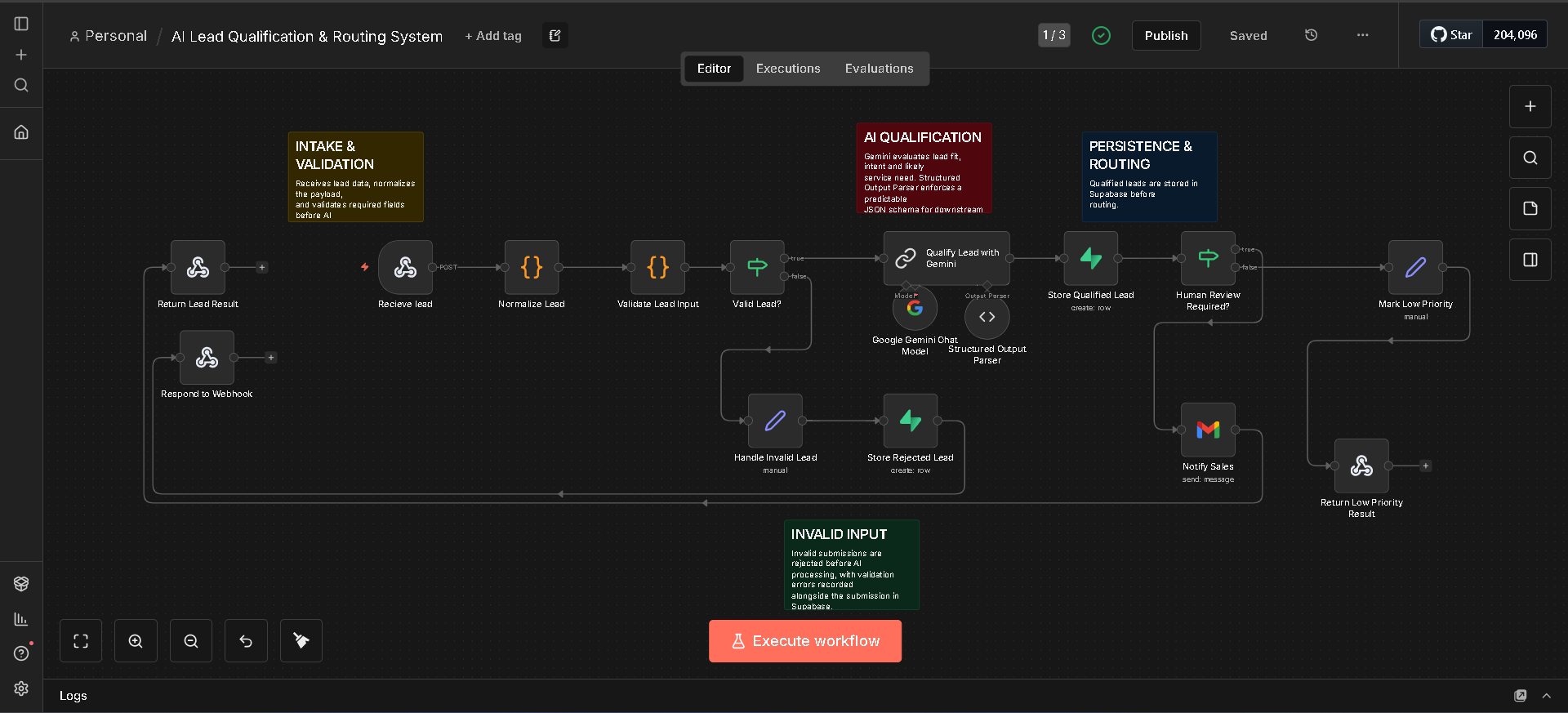
The workflow uses deterministic logic for validation and routing, with Gemini introduced only where interpretation is required.
From lead submission to routing decision.
Manual lead handling can require several connected decisions: checking input, understanding intent, recording information and deciding whether someone should follow up.
Separate deterministic processing from AI interpretation, then persist the structured result before routing.
Qualification criteria are intentionally generic for this demonstration. A production implementation would require domain-specific criteria, evaluation data and monitoring.